
Osteopenia Vs Osteoporosis: What’s the difference?

You may have heard both of these words or if not, now’s a good time to find out more, because it is simply so important to become aware in order to maintain your mobility & independence as you age.
First, a quick word about your bones:
Your bones are not the fixed, static structures most of us imagine them to be. They are living tissue. Right now, as you are sitting reading, your body is constantly breaking down old bone and building new bone in a process called remodelling.
In your younger years, there is balance between this break down & rebuilding with bone density actually peaking somewhere around thirty years of age. After that, the balance shifts ~ for everyone, men & women. Beyond this peak, bone density declines with age, unless we do something about it. For women, especially in the years around menopause, the decline can speed up considerably.
What is Osteopenia?
Osteopenia is the term used when your bone density is lower than what is considered normal, but not low enough to be classified as osteoporosis.
Think of it as a warning zone.
Your bones have lost some density, but they are not at the point where fracture risk is significantly elevated.
If you have had a DEXA or REMS scan (a bone density scan) your results will come back with something called a T-score, here is what that means:
T-score above -1.0: Normal bone density
T-score between -1.0 and -2.5: Osteopenia
T-score of -2.5 or below: Osteoporosis
(The T-score is simply a number that compares your bone density to that of a healthy 30-year-old woman ~ the point in life when bones are at their strongest. Your scan will show other scores too, that you can discuss with your health practitioner, but the T-score is the one most commonly talked about when it comes to assessing fracture risk).
Osteopenia is extremely common in women over 50. It does not automatically mean you will develop osteoporosis, but it is your body’s way of flagging that now is the time to act.
If you haven’t had a scan before, now might be a good time! However, they can be difficult to get access to & expensive, so if this isn’t available for you right now, don’t worry about it, but know that your bones will be losing density – that’s just a scientific fact of ageing, so with or without a scan result just start doing exercise to build bone anyway!
What is osteoporosis?
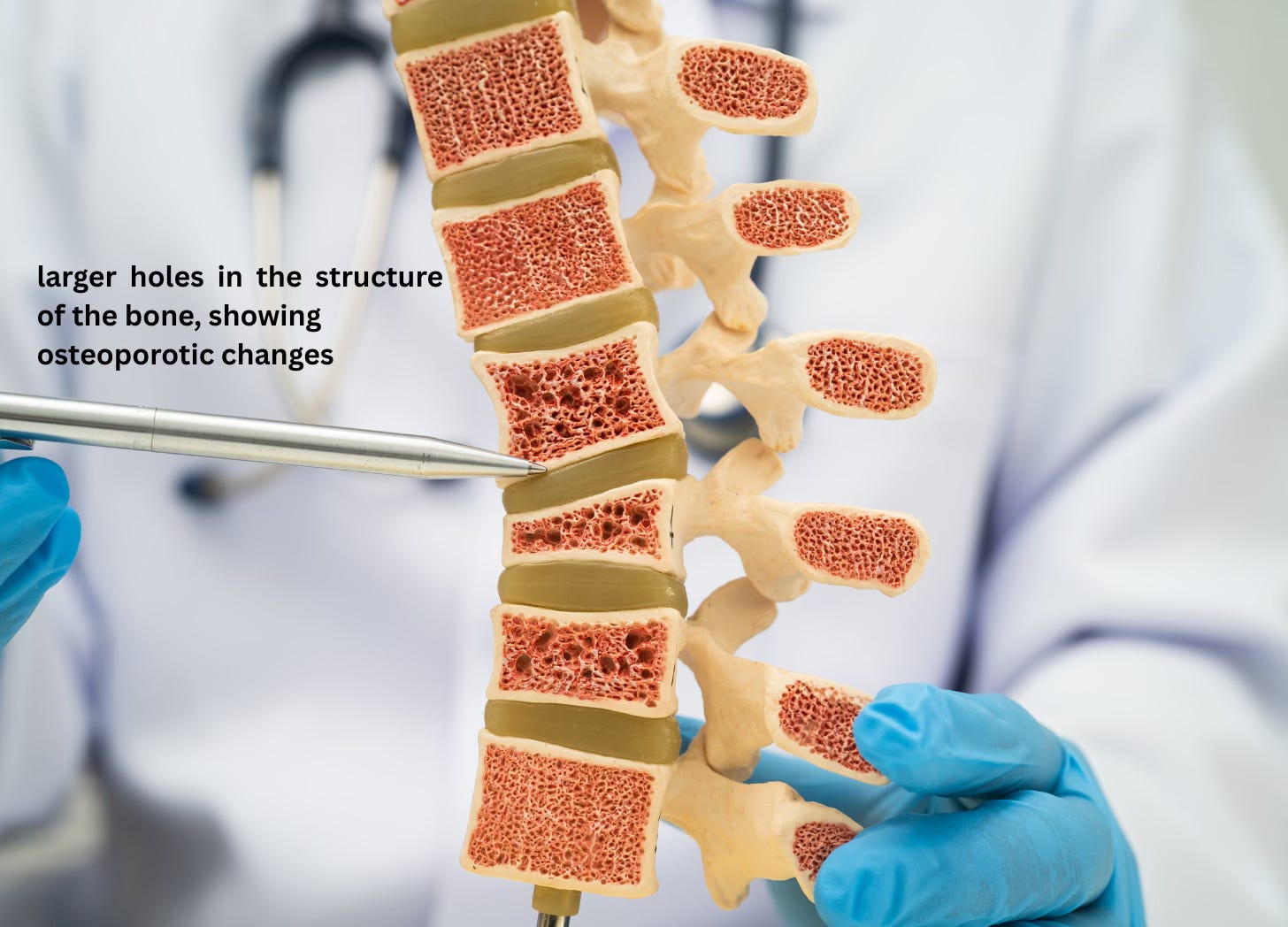
Osteoporosis means your bones have become significantly less dense ~ porous enough that they are at meaningful risk of fracturing, sometimes from surprisingly minor falls or knocks.
The word itself comes from the Latin for “porous bones.” Under a microscope, healthy bone looks like a dense honeycomb. With osteoporosis, those holes become larger and the structure becomes more fragile.
Around one in two women over 50 will experience a fracture related to osteoporosis in their lifetime. The most common sites are the hip, spine, and wrist, all of which can have a significant impact on independence and quality of life.
The challenging thing about osteoporosis is that it has no symptoms. You cannot feel your bones thinning. Which is exactly why knowing the facts and taking action before a fracture happens matters so much.
So what is the actual difference?
The simplest way to think about it:
Osteopenia is lower than ideal bone density. It’s a signal & an opportunity to take action.
Osteoporosis is a medical diagnosis indicating significantly reduced bone density and elevated fracture risk. It requires more active management & working with a health practitioner is recommended.
What to do if you are in the osteopenia zone
If you have been told your bone density is lower than ideal, here is a simple starting framework:
1. Ask your doctor for clarity. What does your T-score actually mean for you, given your age, medical history, and other risk factors? What does your doctor recommend in terms of monitoring? Work with a health practitioner/coach who specialises in bone strength.
2. Start resistance training if you are not already. This is the single most evidence-backed thing you can do for bone health outside of medication. Even twice a week makes a meaningful difference over time. (Keep an eye out over the next few weeks as I’ll be showing you some of my favourites that I do every day without fail)
3. Look at your protein intake. You do not need to go overboard, but you do need to be mindful that you are eating enough & that goes for fibre too, which is actually often more lacking than protein. It’s also important to cut out as much ultra processed foods that you can from your diet, get a variety of different coloured plants on your plate too. This will keep your gut microbiome happy & as with a lot of areas of the body, research is beginning to show just how important the gut is for health, including bone strength. Don’t underestimate the power of your plate!
4. Check your vitamin D levels. Vitamin D helps your body absorb calcium. A simple blood test can tell you where you stand. There are other important vitamins & minerals which are vital for bone strength too that we’ll be talking about here over the coming weeks ~ It’s always best to check your levels first before taking a supplement (too much can also be harmful) & it’s good to work with a practitioner who can advise you on dosage. (if you are on any medication, please check with your pharmacist first before taking supplements)
5. Don’t wait for a diagnosis to take action. You don’t need to have osteoporosis to benefit from everything that protects against it.
What to do if you have been diagnosed with osteoporosis
First, take a deep breath, don’t panic & don’t assume fragility. Many women with osteoporosis live active, strong lives.
Work with your doctor ~ they may recommend medication depending on the severity. Alongside that, work with a health practitioner to do everything listed above, because exercise, nutrition and lifestyle genuinely make a difference at every stage.
Yes, it’s serious, but the goal is not to live carefully, fearful of breaking something ~ the goal is to build the kind of strength that lets you enjoy life independently.
A final thought
Osteoporosis is silent ~ many women I have met over the years in clinic were only diagnosed after they had fractured a bone.
Over the coming weeks, I will be going deeper on what strength training for bone health actually looks like, how much protein you really need, what supplements are worth considering and how to build a sustainable habit that fits around your real life.